Monel sheets and plates are nickel-copper alloy products used in demanding marine, chemical, and industrial environments. The alloy combines corrosion resistance with useful strength and ductility, making it suitable for selected marine and chemical applications. Two grades dominate: Monel 400, a solid-solution alloy chosen for corrosion resistance, and Monel K500, a higher-strength age-hardenable grade.
What Are Monel Sheets and Plates?
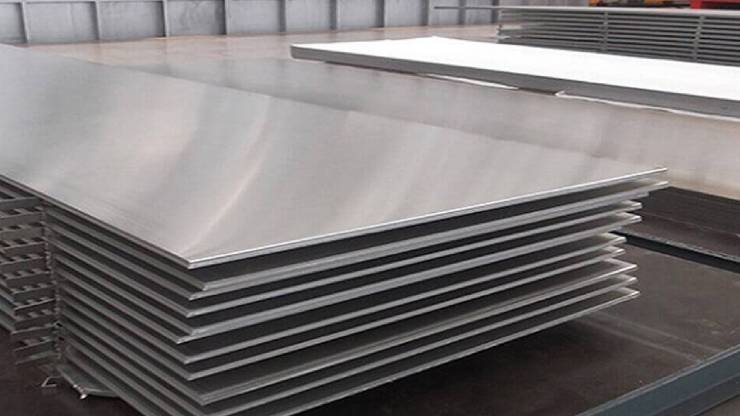
Monel sheets and plates are flat nickel-copper alloy products used for corrosion-resistant applications. They are available in grades such as Monel 400 and Monel K500, which differ in strength, heat treatment, and typical applications. Sheets generally refer to thinner flat products, while plates are used for greater thicknesses and structural or fabricated components. Selection depends on the required thickness, alloy grade, service environment, mechanical properties, and applicable material specification.
Types of Monel Alloys — Monel 400 vs Monel K500
Monel alloys are nickel-copper materials developed for corrosion resistance, mechanical performance, and demanding industrial service. Several Monel grades exist, but Monel 400 and Monel K500 are the most widely recognized grades for sheets and plates.
Monel 400
Monel 400 is a solid solution of nickel and copper in a single phase. Heat treatment cannot harden it. Its characteristics depend on alloy chemistry and processing situation.
Monel 400 is resistant to seawater, hydrofluoric acid, alkalis, and other nonoxidizing conditions. It is typically utilized in maritime applications and as a chemical process component in pumps and valves, heat exchanges, and seawater.
Monel K500
Monel K500 is a nickel-copper alloy with the addition of aluminum and titanium. These additions are precipitate hardeners of the alloy to approximately three times the strength and hardness of Monel 400.
It is usually chosen for service or application in a seawater corrosive and mechanical loading environment. Pump, valves, fasteners, impellers, and other mechanical parts, and marine shafts.
Other Monel Grades
Other Monel grades have also been developed for specific manufacturing or service requirements. These include grades such as Monel R-405, which is a free-machining version of Monel 400 designed to improve machinability.
Monel R-405 is primarily used for machined components rather than applications where maximum corrosion resistance is the only consideration. Its sulfur addition improves machinability but can affect suitability for some welding applications.
Monel 400 vs Monel K500 — Grade Comparison
The two grades share a corrosion matrix but diverge sharply on strength, as the table shows.
|
Property |
Monel 400 (annealed) |
Monel K500 (age-hardened) |
|
Strengthening |
Solid solution, not heat-treatable |
Precipitation (age) hardening |
|
Added elements |
Ni-Cu-Fe |
Ni-Cu plus Al and Ti |
|
Tensile strength |
517 MPa (75 ksi) min |
~1034 MPa (150 ksi) typical |
|
Yield strength |
172 MPa (25 ksi) min |
~724 MPa (105 ksi) typical |
|
Hardness |
110–150 HBW |
250–315 HBW |
|
Typical use |
Seawater and acid piping, valves |
Shafts, stems, high-strength fasteners |
Monel K500 offers markedly higher strength than Monel 400 after suitable age hardening, while the appropriate grade still depends on the service environment and design requirements. Mechanical values apply to the stated condition and standard.
Monel vs Stainless Steel — Which Material to Choose
That determines their places since Monel and stainless steel each derive from different chemistries. Monel is a nickel-copper alloy; stainless steel is chromium-based iron for corrosion resistance.
- Use Monel in seawater (any flow velocity, including impingement) and in hydrofluoric acid, alkalis, and many non-oxidizing acids.
- Select stainless steel where its chromium oxide coating is effective for oxidizing use and general atmospheric or mild chemical service, and cost is a significant factor.
- Cost and availability: Monel is more expensive and in situations where it’s warranted, not as a given.
Overall, there is no superior material. The optimal option is dependent on the individual corrosive media, concentration, temperature, mechanical loading, fabrication requirements, and lifecycle.
Composition & Properties of Monel Sheets and Plates
Nickel and copper are the principal alloying elements in both grades, with nickel at a minimum of 63% and copper around 28 to 34%, carrying the corrosion resistance and base strength.
- Chemical composition: Monel 400 is nickel-copper with a small iron content. Monel K500 adds aluminium (roughly 2.3 to 3.15%) and titanium (roughly 0.35 to 0.85%), the elements that enable age hardening.
- Mechanical properties: Monel 400 reaches 517 MPa tensile and 172 MPa yield in the annealed condition. Monel K500 reaches far higher after ageing, near 1034 MPa tensile and 724 MPa yield.
- Physical properties: both grades share high density and the thermal expansion and conductivity characteristic of nickel-copper alloys.
- Fabrication: Monel 400 forms, machines and welds readily. Monel K500 is formed before ageing, since the hardening treatment develops its final strength.
Monel 400 and Monel K500 properties should never be combined into one set of values, as their strengths differ by condition and grade.
Corrosion Resistance of Monel Alloys in Marine and Chemical Environments
Monel resists seawater even at high velocities, a problem for many alloys. It also offers resistance to hydrofluoric acid, most alkalis, and many non-oxidizing acids. Performance varies on temperature, concentration, flow rate, aeration, and pollutants. Monel is not appropriate in any oxidizing atmosphere, such as some heated aerated sulfuric acid. Corrosion-resistant nickel alloys such as alloy 625 or C-276 may be better suited for those services. Always pick the alloy according to the actual process media.
Monel Sheet & Plate Manufacturing Method
Major Processes of Manufacturing of Monel Sheet and Plate such as Melting, Hot Work, Rolling, and Finish. Melting and alloying produce the desired nickel-copper chemistry and add any additives. The as-cast material is hot-worked and rolled to the desired sheet or plate thickness. Heat treatment develops the condition of the material, and it is here that the grades differ: Monel K500 is precipitation-hardened (aged) to develop strength, while Monel 400 is simply annealed. Finishing and inspection concern dimensions, surface quality, and other appropriate grade criteria. The exact course varies with gradient, thickness, and condition requirements.
Applications of Monel Sheets and Plates in Marine, Oil & Gas, and Chemical Industries
Monel sheet and plate serves industries where corrosion resistance and strength decide the material.
- Marine: seawater-handling components, marine equipment and corrosion-resistant parts exposed to salt water.
- Oil and gas: components in specific corrosive service environments, subject to project requirements.
- Chemical processing: equipment and components used with compatible process chemicals.
- Power and industrial engineering: selected heat-transfer, processing and fabricated components.
Corrosion resistance, strength, fabrication needs and operating conditions together influence the alloy grade and product form. Not every grade suits every application, so suitability is established through service-specific compatibility and engineering review.
How to Select the Right Monel Grade for Industrial Applications
Selecting the right Monel grade follows a practical checklist rather than the grade name.
- Service environment: identify the chemical medium, concentration, temperature and exposure.
- Grade selection: decide whether Monel 400, Monel K500 or another alloy meets the need.
- Mechanical requirements: check design loads, strength, hardness and ductility.
- Dimensions: confirm thickness, width, length, tolerances and fabrication allowance.
- Material condition: verify the required heat-treated or supplied condition.
- Quality documentation: review material test certificates, applicable standards and traceability.
- Lifecycle cost: weigh fabrication, maintenance, service life and replacement.
Material selection should rest on both corrosion compatibility and mechanical design requirements together.
Conclusion
Monel sheets and plates offer useful combinations of corrosion resistance and mechanical performance for selected marine, chemical and industrial applications. Choosing between Monel 400 and Monel K500 comes down to the service environment, the strength required, the fabrication needs and the material condition, since the corrosion-led 400 and the high-strength K500 are built for different duties. Verifying technical specifications and material certification confirms suitability before purchase. At Triton Alloys, we can assist with Monel sheet and plate requirements based on grade, dimensions, material condition, and certification needs.