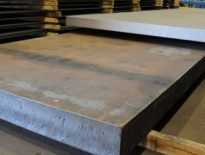
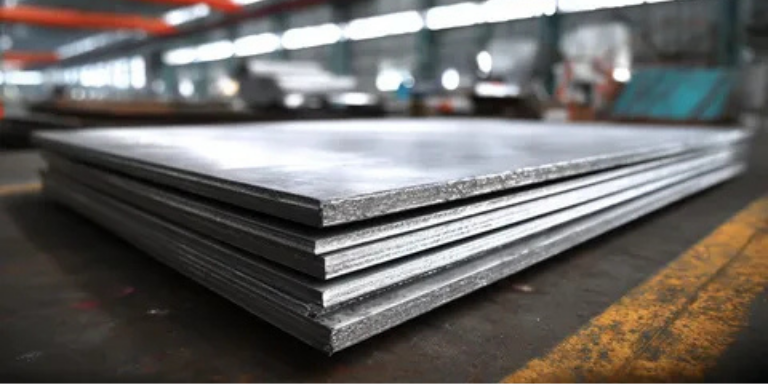
A stainless steel plate is a flat-rolled steel product with chromium in it, giving corrosion resistance that ordinary carbon steel doesn’t have. These plates come in different grades, thicknesses, finishes and manufacturing conditions, each suited to a different job. Picking the right one means weighing grade, thickness, finish, manufacturing method, corrosion environment, application, standards and budget together. This guide covers all of that, plus pricing and how stainless steel plate compares to MS plate.
What Is Stainless Steel Plate?
Stainless steel plate has a minimum chromium content of 10.5%, which gives it corrosion resistance. Chromium reacts with oxygen and forms a thin oxide layer, blocking further oxidation underneath. Plate, sheet and strip are grouped mainly by thickness: plate usually starts above 4.5 to 6 mm, sheet covers thinner gauges, and strip is narrow coiled material. Stainless steel plate dimensions typically run from 3 mm up to over 100 mm, in sizes like 1500 x 3000 mm. Grades 304, 316, 410 and 430 are common, in finishes from mill-rolled to mirror-polished.
Stainless Steel Plate Grades Explained
Grade decides how a plate holds up under load, heat and chemical exposure.
| Grade | Type | Key Property | Typical Applications |
| 304 | Austenitic | General corrosion resistance | Food, fabrication |
| 316 | Austenitic | Chloride resistance | Marine, pharma |
| 410 | Martensitic | Hardness/strength | Industrial components |
| 430 | Ferritic | Good oxidation resistance | Appliances, architecture |
Stainless Steel 304 Plate
Stainless Steel 304 Plate is austenitic, easy to form and weld. Used in food processing and general fabrication.
Stainless Steel 316 Plate
Stainless Steel 316 Plate has molybdenum added, pushing resistance to chloride environments past 304. Marine and pharmaceutical work lean on this grade.
Stainless Steel 410 Plate
Stainless Steel 410 Plate is martensitic and heat-treatable for higher hardness. Cutting tools and shafts use 410.
Stainless Steel 430 Plate
Stainless Steel 430 Plate is ferritic with decent oxidation resistance. Appliance panels and architectural trim go for 430.
Stainless Steel Plate Thickness Chart
Thickness is usually given in millimetres or inches. Gauge numbers still turn up in some markets, but conversions vary by standard, so confirm actual thickness.
| Thickness | Approx. Inch |
| 3 mm | 0.118 in |
| 5 mm | 0.197 in |
| 6 mm | 0.236 in |
| 10 mm | 0.394 in |
| 12 mm | 0.472 in |
| 20 mm | 0.787 in |
| 25 mm | 0.984 in |
Which thickness works best depends on mechanical load, pressure, temperature, fabrication needs, corrosion allowance and application.
Stainless Steel Plate Finishes Explained
Finish affects appearance, cleanability and how the plate behaves during fabrication.
2B Finish
A smooth, reflective mill finish, used for industrial and general work.
No. 4 Finish
A brushed finish with a directional grain, common in food equipment and panels.
Mirror Finish
Highly reflective, chosen where appearance and cleanability matter.
Hairline Finish
Fine, continuous lines running one direction, mostly used in architectural work.
Finish choice comes down to appearance, cleanability and end use.
Stainless Steel Plate Tolerance as per ASTM A480
ASTM A480/A480M sets out general requirements for flat-rolled stainless products, including plate. It covers thickness tolerance, width and length, flatness and edge condition, but there’s no single fixed figure for every plate. What applies depends on the nominal dimensions and the specification on the order. For ASTM A480 stainless steel plate tolerance, check the clause for your size, since stainless steel plate thickness tolerance and stainless steel plate dimensional tolerance shift with width and thickness.
How Stainless Steel Plate Is Manufactured: Hot Rolled vs Cold Rolled
Manufacturing starts with steelmaking and slab production, then hot rolling to bring down thickness. Annealing and pickling restore corrosion resistance and clear scale, with cold rolling applied where a smoother finish is needed.
| Feature | Hot Rolled | Cold Rolled |
| Processing | Rolled at elevated temperature | Further rolled after hot rolling |
| Surface | Typically less smooth | Smoother surface |
| Dimensional precision | Moderate | Higher |
| Typical use | Heavy-duty fabrication | Applications requiring better finish/precision |
Why Stainless Steel Plate Resists Corrosion
Chromium reacts with oxygen and forms a thin, chromium-rich oxide layer on the surface. This passive film stops oxygen and moisture from reaching the base steel. If scratched but not badly gouged, it reforms once oxygen is around again. 316 generally does better than 304 in chloride-rich settings like seawater because molybdenum strengthens the film against pitting. Stainless steel is corrosion-resistant, not rust-proof.
Stainless Steel Plate Uses in Food & Pharma Industry
Hygienic industries pick stainless steel because it resists contamination, cleans easily, and holds up through washdowns.
Food Industry: Processing equipment, storage tanks, preparation surfaces and mixing equipment use stainless steel plates for corrosion resistance under acidic conditions.
Pharmaceutical Industry: Process equipment, storage systems and cleanroom fabrication rely on stainless steel for durability, provided it’s properly specified. Grade and finish should match the process conditions.
Stainless Steel Plate Price per Kg: 2026 Market Guide
Stainless steel plate price per kg moves with a few things, not one fixed number:
- Grade 316 usually costs more than 304 because of molybdenum)
- Thickness and plate size
- Surface finish
- Order quantity
- Manufacturing specification
- Market conditions and alloying-element costs
- Processing and cutting requirements
- Supplier location
Approximate Material Cost = Weight × Price per kg
Compare quotations only when grade, thickness, dimensions, finish and quantity match across suppliers.
Stainless Steel Plate vs MS Plate
Corrosion resistance and hygiene needs usually settle this choice.
| Factor | Stainless Steel Plate | MS Plate |
| Corrosion Resistance | High, passive oxide layer | Low, needs coating |
| Maintenance | Minimal | Regular, to prevent rust |
| Appearance | Bright, finish options | Dull |
| Initial Cost | Higher | Lower |
| Hygienic Applications | Well suited | Not suited without lining |
| Typical Uses | Food, pharma, marine | Structural, construction |
Stainless steel is often the better choice where corrosion resistance justifies the higher upfront cost.
How to Choose the Right Stainless Steel Plate?
Start with the operating environment, since chlorides, chemicals, or moisture narrow down grade options fast. Pick the grade that fits, work out the thickness for the load involved, and choose a finish based on appearance and cleanability. Confirm the ASTM/ASME specification and compare supplier quotations on the same terms.
Conclusion
Grade alone doesn’t decide the right stainless steel plate. Thickness, finish, manufacturing route, tolerance and service environment all play a part. Triton Alloys supplies stainless steel plate along with quenched and tempered steel plate, high strength steel plate, HIC plate and alloy steel plate to refineries, power plants, defense and oil & gas projects. Get in touch for a quote matched to your requirements.
FAQs
What is stainless steel plate used for?
Food processing, storage tanks, chemical vessels, marine structures, construction and pharmaceutical processing, mainly where corrosion resistance matters.
Which stainless steel plate is better, 304 or 316?
316 does better in chloride-rich environments like seawater, thanks to molybdenum. 304 works fine for general fabrication and costs less.
What is the standard for stainless steel plate?
ASTM A240/A240M covers chemical and mechanical requirements. ASTM A480/A480M governs tolerance, flatness and edge condition.
What is the difference between 2B and No. 4 stainless steel finish?
2B is a smooth mill finish for general use. No. 4 has a brushed, directional grain, common in food equipment.
How is stainless steel plate price calculated?
Weight multiplied by price per kg, with the rate depending on grade, thickness, finish and quantity.