Tool rooms reach for A2 Tool Steel Round Bars when a die has to hold its dimensions through hardening and still survive shock loading on the press. A2 hardens in still air, so distortion stays low compared with oil or water quenched grades. That single characteristic shapes most of its tooling use. This guide walks through material condition, the heat treatment sequence, how A2 stacks up against D2, how the bars reach finished stock, what to check before ordering, and where the grade performs in industrial tooling.
What Are A2 Tool Steel Round Bars?
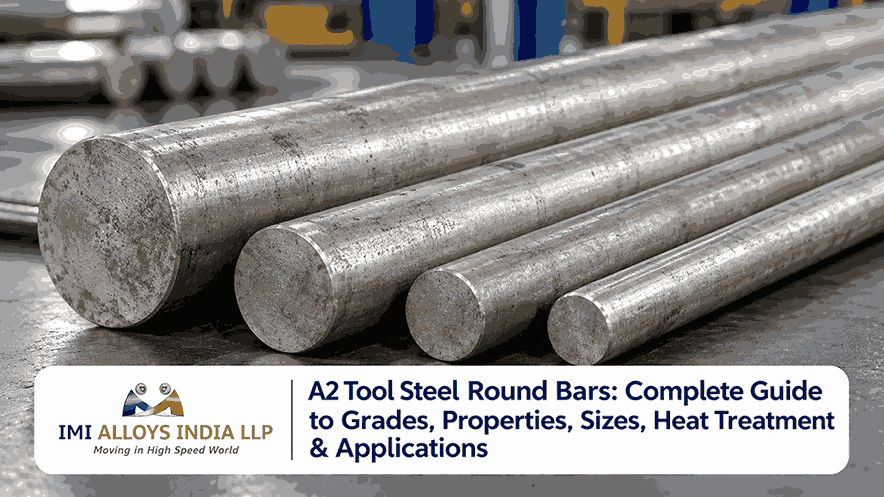
A2 Tool Steel Round Bars are medium-alloy cold work tool steel in round section that hardens in air. Wear resistance, toughness, and size stability suit dies, punches, and forming tools.
Air hardenability comes from the chromium and molybdenum content. Shops cut the bar soft, then harden it with little dimensional movement, holding tight tolerances. Round stock fits turning, boring, and punch work. Impact resistance beats high-carbon high-chromium grades on interrupted cuts.
A2 Tool Steel Round Bars: Annealed vs Hardened Condition
Material condition decides what the shop can do with the bar on arrival. The table below sets out the two states.
| Condition | Characteristics | Typical Purpose |
| Annealed | Softer and easier to machine | Machining and fabrication |
| Hardened | Higher hardness and wear resistance | Finished tooling applications |
Order annealed bar when the tool still needs machining, since it cuts cleanly. Hardened bar resists wear but demands grinding. Check hardness against the material specification instead of assuming figures.
A2 Tool Steel Round Bar Heat Treatment Process
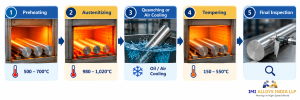
Heat treatment builds the hardness, toughness, and size stability the finished tool depends on.
- Preheating: Raising the bar slowly to an intermediate temperature equalises the section and limits thermal shock before full austenitizing heat.
- Austenitizing: Holding at austenitizing temperature dissolves carbides into solution and forms the structure needed for hardening.
- Quenching or air cooling: Still air cooling transforms austenite to martensite while keeping distortion lower than liquid quench methods.
- Tempering: Reheating after hardening relieves stress, reduces brittleness, and sets the working balance between hardness and toughness.
- Final inspection: Checking hardness, straightness, and dimensions confirms the treated bar meets the tooling specification before release.
| Stage | Purpose |
| Preheating | Reduce thermal stress |
| Austenitizing | Develop required structure |
| Cooling | Harden the material |
| Tempering | Balance hardness and toughness |
Exact temperatures and soak times must follow the applicable grade specification and the approved heat treatment procedure.
A2 Tool Steel Round Bars vs D2 Tool Steel Round Bars
Both grades air harden, so the comparison turns on how each handles wear against impact.
| Factor | A2 Tool Steel | D2 Tool Steel |
| Hardening | Air hardening | Air hardening |
| Toughness | Generally higher | Generally lower |
| Wear resistance | High | Very high |
| Dimensional stability | Good | Good |
| Typical preference | Balanced toughness and wear | Higher wear resistance |
Pick the grade against the tooling environment. Heavy abrasive wear with steady loading favours D2, while shock loading, thin sections, and interrupted work favour A2.
A2 Tool Steel Round Bar Manufacturing Process
The process begins at the melt shop, where chromium, molybdenum, and vanadium set the alloy chemistry. Casting produces ingot or billet. Forging or rolling then breaks down that cast structure and spreads carbides more evenly through the section. Annealing softens the bar ahead of machining, while surface conditioning strips scale and decarburised skin. Straightening and cutting fix the length. Dimensional checks and inspection close the route, fixing grain structure, size, surface finish, and shipping condition.
How to Select the Right A2 Tool Steel Round Bar
Work through these points before releasing an order.
| Selection Factor | What to Check |
| Diameter | Required bar size |
| Length | Standard or cut length |
| Condition | Annealed or hardened |
| Tool requirement | Wear and toughness |
| Heat treatment | Required final condition |
| Machining | Manufacturing requirements |
| Standard | Applicable material specification |
| Testing | Required inspection or certification |
Match condition and dimensions to the tooling design and the shop’s manufacturing route.
A2 Tool Steel Round Bars for Industrial Tooling Applications
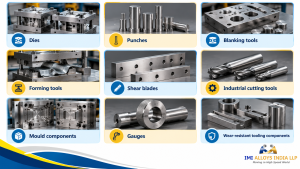
- Dies: Cold work dies hold form accuracy through repeat cycles because A2 resists both abrasion and size change.
- Punches: Punch bodies take compressive shock on every stroke, where A2 toughness limits chipping at the nose.
- Blanking tools: Blanking edges cut sheet repeatedly, and A2 keeps edge geometry sharp across long production runs.
- Forming tools: Forming surfaces slide against workpiece metal under load, so wear resistance protects the profile.
- Shear blades: Shear edges meet interrupted impact loading, a duty that suits the toughness end of A2 performance.
- Industrial cutting tools: Cutting components keep working edges in abrasive contact, where A2 extends regrind intervals.
- Mould components: Mould inserts and cores need stable dimensions after hardening to protect cavity tolerances.
- Gauges: Gauge bodies depend on size stability, since any movement during hardening destroys measurement accuracy.
- Wear-resistant tooling components: Guides, strippers, and wear plates survive sliding contact without rapid surface loss.
Across all of these, the pull is the same combination: wear resistance for tool life, toughness against shock, dimensional stability through hardening, and air hardening that keeps distortion controllable.
Conclusion
A2 Tool Steel Round Bars earn their place in tool rooms that need wear resistance and toughness in one material without losing dimensional control during hardening. Getting the order right means fixing four things up front: diameter and length, annealed or hardened condition, the heat treatment route the tool requires, and the material specification the job calls for. IMI ALLOYS INDIA LLP stocks and supplies round bars, square bars, and flat bars in Tool Steel, Alloy Steel, and High-Speed Steel, as authorised dealers of Graphite India Limited (POWMEX STEELS DIVISION) and authenticated stockist of Nachi Fujikoshi Corp in India.
Contact IMI ALLOYS INDIA LLP for diameter availability and material condition on your A2 requirement.