Titanium weighs roughly 45% less than steel of the same volume, yet Grade 5 matches the tensile strength of many structural steels. Design teams in aerospace, marine and chemical plants work that trade-off every day. Titanium Sheet & Plate covers the flat-rolled forms of the metal, supplied in commercially pure and alloy grades for equipment exposed to seawater, acids and sustained mechanical load. This guide walks through the difference between the two forms, available grades, heat treatment, corrosion behaviour, the manufacturing route, a selection method, sizes, standards and end applications.
What Is Titanium Sheet & Plate?
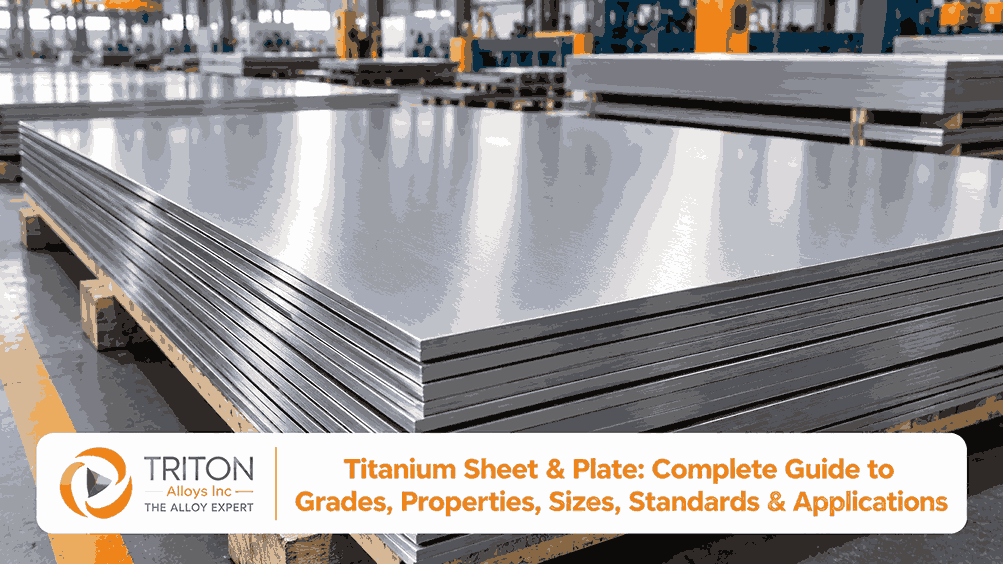
Titanium Sheet & Plate are flat-rolled titanium products supplied in commercially pure and alloy grades. Sheet covers thinner material used for formed and fabricated parts. Plate covers heavier sections used for structural and pressure-retaining components across marine, chemical and aerospace service.
Both forms carry the same metallurgical advantages. A high strength-to-weight ratio lets designers cut component mass without surrendering load capacity, which matters in airframes and rotating assemblies. A self-forming oxide film shields the surface in chloride-rich and oxidising media, so maintenance intervals stretch out in plant service. Refineries, desalination units, heat exchanger shops and defence fabricators all draw on these two forms.
Titanium Sheet vs Titanium Plate: Key Differences
Thickness drives most of the separation, and thickness in turn governs weight, fabrication route and structural role.
| Factor | Titanium Sheet | Titanium Plate |
| Thickness | Generally thinner | Generally thicker |
| Fabrication | Forming and cutting | Cutting and machining |
| Use | Lightweight components | Heavy-duty components |
| Selection | Based on application | Based on structural requirements |
Titanium Sheet & Plate Grades
Commercially pure grades carry titanium with controlled oxygen and iron levels, which keep ductility high and forming simple. Alloy grades add aluminium, vanadium, palladium or molybdenum to lift strength or sharpen corrosion performance in specific media.
| Grade | General Characteristic |
| Grade 1 | High ductility and corrosion resistance |
| Grade 2 | Balanced strength and corrosion resistance |
| Grade 5 | High-strength titanium alloy |
| Grade 7 | Enhanced corrosion resistance |
| Grade 9 | Moderate strength and good formability |
| Grade 12 | Strength and corrosion performance |
Grade choice follows four inputs: strength demand, corrosion environment, fabrication method and service requirements. Triton Alloys supplies titanium sheet and plate against custom-made specifications, tested before dispatch under an ISO 9001:2015 system.
Titanium Sheet & Plate Heat Treatment & Annealing
Heat treatment conditions titanium after rolling, welding or forming. Annealing restores a uniform microstructure and recovers ductility for downstream fabrication work. Stress relieving clears residual stresses left by rolling and machining, which protects dimensional stability during cutting and in service. Solution treatment and ageing apply only to selected alloy conditions, where the ageing response lifts mechanical properties. Requirements shift grade by grade, so the governing product specification sets the cycle.
| Treatment | Purpose |
| Annealing | Improve material condition |
| Stress Relieving | Reduce residual stresses |
| Solution Treatment | Applicable to selected alloys |
| Aging | Applicable to selected material conditions |
Titanium Sheet & Plate Corrosion Resistance
A titanium dioxide film forms the moment the surface meets oxygen, and it rebuilds within seconds once scratched. That passive layer carries the corrosion performance. In marine atmospheres and seawater, commercially pure grades resist the pitting and crevice attack that strips carbon steel inside a single season. Chemical plants run titanium in oxidising acids, chloride solutions and bleaching streams, and process operators also specify it for heat exchanger bundles handling brine. Real performance tracks grade, temperature, concentration and exposure time, so match the material against tested service data.
Titanium Sheet & Plate Manufacturing Process
- Raw material preparation: Sponge titanium and alloying additions get blended and compacted
- Melting and ingot production: Vacuum arc remelting produces a clean, homogeneous ingot
- Hot working: Forging or breakdown rolling converts the ingot into slab form
- Rolling: Hot and cold passes reduce the slab to sheet or plate thickness
- Heat treatment: Annealing or stress relief sets the required material condition
- Surface finishing: Pickling, grinding or polishing removes scale and alpha case
- Cutting and sizing: Shearing, plasma or waterjet cutting delivers ordered dimensions
- Inspection and testing: Ultrasonic, chemical and mechanical checks confirm conformity
Process control at these stages fixes thickness tolerance, surface quality and the delivered material condition.
How to Select the Right Titanium Sheet or Plate
Eight inputs settle most purchase decisions. Work through them in order, because grade and product form constrain everything downstream.
| Factor | Consideration |
| Grade | Strength and corrosion requirements |
| Product Form | Sheet or plate |
| Thickness | Application requirements |
| Dimensions | Required length and width |
| Environment | Chemical, marine, or industrial exposure |
| Fabrication | Cutting, forming, welding, machining |
| Standards | Required product specification |
| Testing | Inspection and certification |
Match the written material specification to the actual operating conditions.
Conclusion
Choosing between Titanium Sheet & Plate comes down to grade, thickness, dimensions, service environment, fabrication route and the standard that governs the order. Get those six right and the material performs for decades. Share your drawing, grade and quantity with Triton Alloys for a quotation against your specification.