Choosing the correct steel plate grade during the specification stage prevents expensive substitutions and structural failures later on. Triton Alloys is an ISO 9001:2015 certified manufacturer and global distributor of industrial steel plates catering to the needs of engineering and procurement teams in refineries, construction, power plants, offshore structures and defense sectors. Triton Alloys supplies both A283 GR.C plates and ASTM A36 plates.
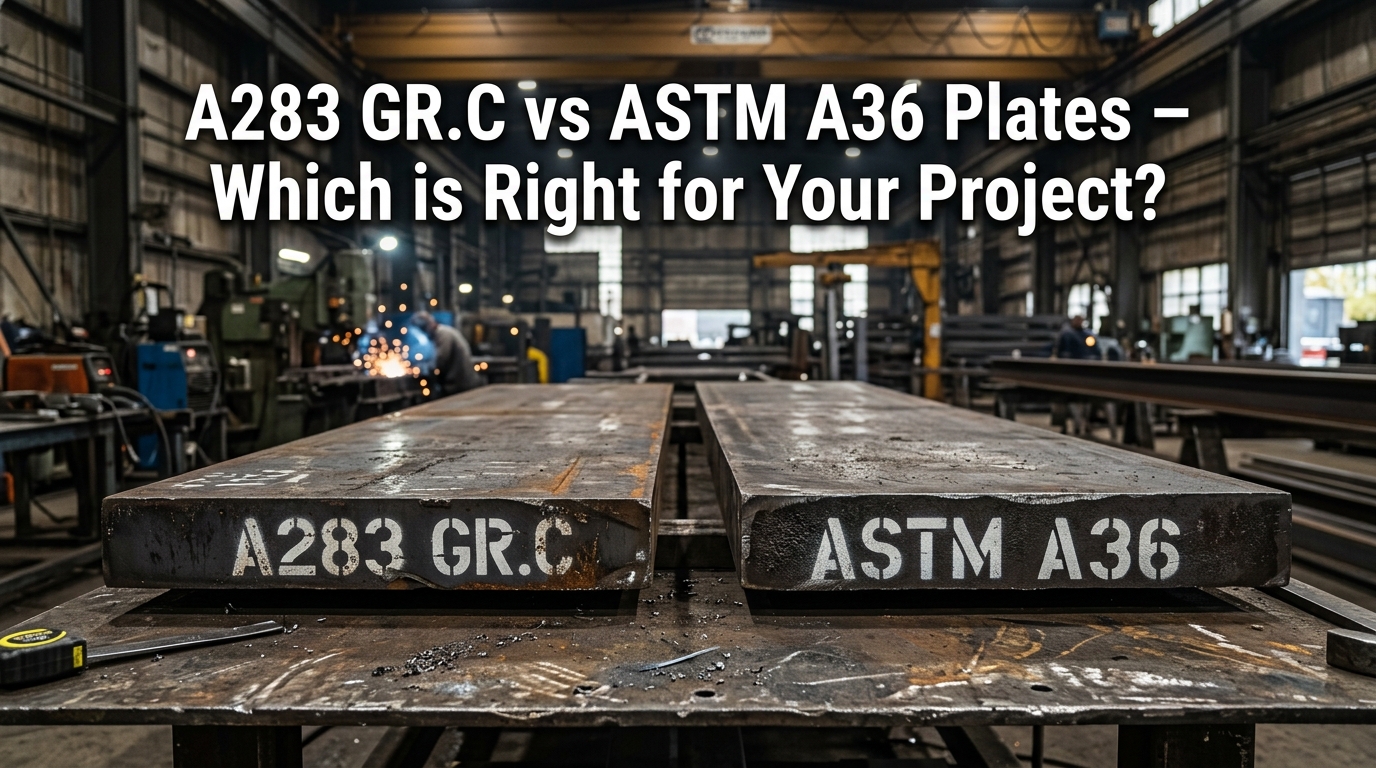
Both grades are in the Mild Steel plate category and are widely available, but not interchangeable for all applications. The difference between A283 GR.C and ASTM A36 is that they are different in standards, mechanical strength and structural requirements. The wrong choice affects weldability, code compliance and long-term reliability. This article covers what each grade is, how their properties compare side by side, and which applications each one suits.
Understanding A283 GR.C Steel Plates
A283 GR.C is a low and intermediate-tensile-strength Carbon Steel plate produced under the ASTM A283 standard. The standard details four grades (A, B, C and D). Grade C is most often specified for general fabrication and pressure vessel components.
Key mechanical properties for A283 GR.C plates:
- Tensile strength: 380–515 MPa
- Yield strength (minimum): 205 MPa
- Elongation: Minimum 25% in 200 mm gauge length
The chemical composition is tightly controlled. Carbon content is kept at a maximum of 0.24%, manganese at 0.90% maximum, phosphorus at 0.035% maximum, and sulphur at 0.040% maximum. This low-carbon ceiling makes the grade inherently weldable without pre-heat in most standard fabrication environments.
A283 GR.C Plates are mainly used in atmospheric storage tanks and pressure vessels under moderate conditions and structural fabrications with lower strength requirements. The predictable deformation under load of the moderate yield point of the grade is a useful property for the construction of tank shells and non critical structural components.
Understanding ASTM A36 Steel Plates
ASTM A36 is a structural Carbon Steel plate specified under the ASTM A36/A36M standard. It is one of the most widely used structural steel grades across the world, especially for construction, bridge building and general structural steel purposes.
Key mechanical properties for ASTM A36 plates:
- Tensile strength: 400–550 MPa
- Yield strength (minimum): 250 MPa
- Elongation: Minimum 20% in 200 mm gauge length
The chemical composition of ASTM A36 varies slightly with plate thickness. For plates up to 20 mm, carbon content can reach 0.25% maximum; for thicker plates, the maximum rises to 0.26–0.29% depending on thickness. Manganese ranges from 0.80–1.20%, with phosphorus at 0.04% maximum and sulphur at 0.05% maximum.
ASTM A36 Plates carry a higher minimum yield strength than A283 GR.C. This makes them the standard choice for structural beams, columns, base plates, and connections where load-bearing capacity governs the design. The grade also satisfies a broad range of international structural fabrication codes.
A283 GR.C vs ASTM A36: Key Differences at a Glance
The table below captures the core differences in this mild steel plate comparison. Both grades are Carbon Steel, and both weld well, but the numbers indicate clearly where each one belongs.
| Property | A283 GR.C | ASTM A36 |
|---|---|---|
| Governing standard | ASTM A283 | ASTM A36/A36M |
| Tensile strength | 380–515 MPa | 400–550 MPa |
| Minimum yield strength | 205 MPa | 250 MPa |
| Max carbon content | 0.24% | 0.25–0.29% (thickness-dependent) |
| Elongation (min) | 25% in 200 mm | 20% in 200 mm |
| Primary use | Storage tanks, pressure vessels | Structural steel, construction |
| Weldability | Excellent | Good |
| Typical plate thickness | 6–100 mm | 6–200 mm |
| International structural code use | Limited | Widely accepted |
A283 GR.C offers better elongation and a lower carbon ceiling, which supports superior weldability. ASTM A36 delivers higher yield strength and a wider thickness range, which is why structural engineers reach for it first.
When Should You Choose A283 GR.C?
When the application needs weldability, ductility, and moderate pressure or fluid containment (not maximum structural load), the correct specification is A283 GR.C.
It is most commonly used in atmospheric storage tanks. Tank shells holding water, petroleum products, or chemicals at ambient pressure operate well within the grade’s strength envelope. The high elongation figure (minimum 25%) means the plate absorbs stress without cracking at weld seams during thermal cycling.
Fabricators working on non-fired pressure vessels and heat exchanger shells under ASME Section VIII also specify A283 GR.C regularly. The controlled carbon content keeps heat-affected zones clean and reduces post-weld heat treatment requirements.
Industries served include oil storage terminals, water treatment facilities, and chemical processing plants at low to moderate pressures.
When Should You Choose ASTM A36?
ASTM A36 is the default grade of structural steel plate for structural steel fabrication. With a minimum yield strength of 250 MPa, wide thickness availability and code acceptance, it is the practical choice wherever structural calculations dictate the specification.
Structural beams, columns, and base plates in commercial and industrial construction are the primary applications. The material meets the requirements of the commonly used international structural codes, which simplifies the preparation of design documents and purchase.
ASTM A36 is also widely used for making bridge components, machinery frames and crane structures. These applications are related to dynamic loading and stress concentration. The tensile range (400-550 MPa) with good ductility, handles cyclic loads without brittle failure.
Fabrication shops also favour ASTM A36 because it is available in heavy thicknesses (up to 200 mm) and covers a wide range of structural work from a single stock grade.
Which Grade is Right for Your Project?
The choice between A283 GR.C and ASTM A36 depends on what the application needs are: weldability and ductility versus structural load bearing capacity.
Choose A283 GR.C if:
- The application involves atmospheric or low-pressure storage tanks
- Maximum weldability and elongation are priorities
- The design standard specifies ASTM A283
- Post-weld heat treatment must be minimised
Choose ASTM A36 if:
- The project involves structural beams, columns, or load-bearing frames
- A yield strength of 250 MPa minimum is required by design
- The specification must comply with international structural codes
- Heavy plate thicknesses (above 100 mm) are needed
Triton Alloys stocks both grades and supplies custom-cut plates to exact project dimensions. As an ISO 9001:2015 certified A283 GR.C plate supplier and ASTM A36 plate stockist, we provide material test certifications, inspection reports, and full documentation with every order. Contact our team with your specifications to confirm the correct grade, available dimensions, and lead times.